Step 1: Qualification.
Despite winning the DBNI last year, I was not given an automatic qualification to this year’s edition. So I had to go through the qualification slog. A lack of convenient tournaments, given the North American bias of the vFtF scene, and the cancellation of Cascadia meant that I had to rely on some PBEM results together with some players dropping out in order to make it back to the start list this February.
Given the title of this post, I guess I could just say the easy way to not defend my title would be to not qualify, but having qualified, I had to work harder to not defend it.
Round 1: Germany. (backstabbr link)
I “chose” Germany under the auction system in place for the selection of powers. It’s a secret bidding system, hence the quotation marks. I won’t discuss it further except to ask that anyone who discovers the optimal solution please write to me with details.
Evan is in France, with Ben in England. Surely I can work with one of them right? Matt is along for the ride beside me in Russia and one year ago when we were in the same positions, he came much to close to comfort to a solo, an experience I’d rather not repeat. Rounding out the board are Liam in Italy, Katie in Austria and the unstoppable Farren in Turkey. Interesting stat about Farren: Going in to this tournament, in games we’ve played together where we’re not neighbours, her SC counts are 12, 11, 13 and 10. If that continues, it doesn’t leave many centres for me to fight over.
Evan informs me he is ordering PAR-PIC, MAR-BUR so I bounce the latter and get “rewarded” for doing so by being bounced out of HOL by Ben. Not the best of starts, and when Italy walks into MUN in ’02 and BER in ’03, things are looking grim. But with Evan not fully committed to the EF and Ben distracted in Scandinavia, I’m able to hold on until the French move into IRI gives me the diplomatic space to get back in the game.
Now we arrive at a key moment in the game. I’m allied with France and meanwhile a strong Austro-Turkish alliance has blossomed on the other side of the board. I recognise that my chances to top this board depend on not being the next Austrian target. So I negotiate with Katie to give her the space to do absolutely anything except attack me and …
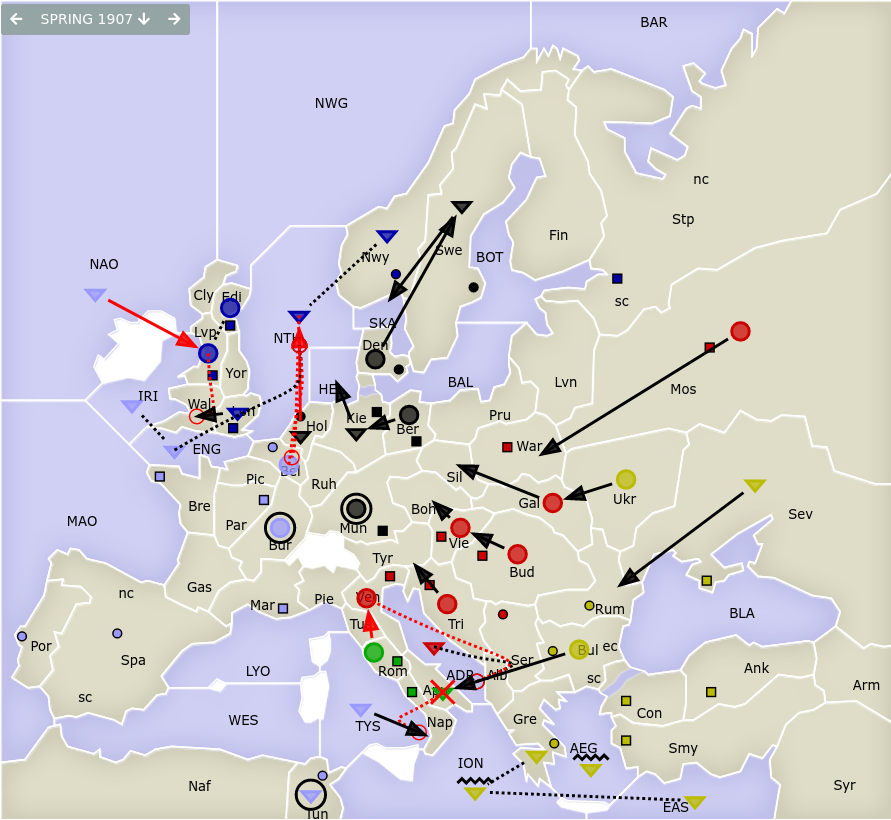
Nope. Farren’s hypnotic powers are total and I am unable to break them.
I try consoling myself with the fact that I am far from the only person unable to break them but it doesn’t work.
The FG goal now becomes to capture the remainder of the English centres while forming a line against AT. All is going according to plan (except, from my point of view, for Evan failing to order ENG-MAO) and then we see this piece of funkiness.

F NTH C LON-YOR
In all my time playing diplomacy, I’ve never been in a game with a kidnapped convoy before, so part of me is happy this happened, even if it seriously jeopardised my chances in the game. I’m also happy that backstabbr allows kidnapped convoys – I’ve seen some fun-hating tournament directors have rules against kidnapping convoys in their tournament rules. The piece de resistance is that I didn’t know that Evan was ordering LON-YOR, nor did I know that Ben would order YOR-LON. In fact Ben and I didn’t even talk that turn!
Some tense negotiation was needed to get from this new position to a draw, but we managed to stalemate the AT and I was left with a 7sc draw second to a Farren’s 10sc Turkey. A nice little secondary score to add to a good score, but not the board top I wanted – I would now have to find a way to pull that off in the next round.
Round 3: Turkey. (backstabbr link)
[Not round 2. The tournament structure is play one of Rounds 1 and 2, and one of rounds 3 and 4].
Suffice to say that I did not want to play Turkey. The fundamental problem with playing Turkey is that your three neighbours covet your corner position, which creates a bias towards early attacks on Turkey.
At the start of the game as Turkey, the clock is ticking. You have three game years to make soemthing happen, otherwise you’re dead.
1901 came and went with no progress, only with Christophe in Austria lying to me about wanting an AT.
In 1902 I was able to hold Bulgaria due to Russian neutrality, but Greg wasn’t intereted in actively working with me and turned down my offer of Serbia. The neutrality did buy me an extra year though.
1903 and there’s still no progress. For some unknown reason Austria tries to take CON with the wrong unit so I keep it.
Fall 1904, with an Italian fleet already docked in Smyrna and finally we see a crack with an Austrian swing at RUM. We’ve survived the onslaught and are back in the game. Let’s go! Interestingly once this happened, I started getting much more nervous, believing I had a real chance again.
Meanwhile, on the other side of the board, after some initial indications of an FG, Karthik (E) and Farren (F) had entered into a strong alliance, which quickly swept aside Timothy in Germany and was looking to roll the board. Not wanting to sit in the corner on 3 for the rest of the game, I played an aggressive game, cooperating with Greg to pick up a couple from Italy in a single year, before turning on Greg himself, all while the EF marched onwards.
This changed in Fall 1910, when Russ explained to the rest of the southern powers how we could form a 14 centre stalemate line in two turns, assuming we made a couple of good guesses. I went for it, looking for something to break up the EF. One nervous wait for adjudication later to find out if my convoy to APU would be disrupted and we made it.

Stalemate
And went straight into the final phase of the game. Where nothing moved. I figured Karthik would stab, given he needed a strong board top to make it through to the final. And yet the stab never came. Meanwhile I was busy holding my line, with EF (together or separately) not offering me any inducements to stab that I felt I could take seriously.
However despite nothing happening, Karthik would not agree to a draw. Now most tournaments have a rule along the lines of the Tournament Director being able to force a draw if there is no significant change in a certain amount of time. But the DBNI did not have such a rule, though now thanks to us, it does. At some point Zach (our TD) came in and told us that he was instigating this rule for this game, starting from when he announced it to us.
Still nothing of substance changed, with some turns going by quickly due to everyone clicking to adjudicate early and others being taken up with frantic negotiation between myself, Farren and Karthik. And so with Karthik taking Kiel on the last turn for an 11sc board top, we were force drawn with me on 8 centres, ending my bid to defend my title.
I am pleased I got to fight in some good-spirited and well-fought tough games. I specifically enjoyed getting to play against two quality players I had never played before in Christophe and Greg in my last game and I hope to cross swords with them on a board again soon. Special mention and congratulations must go to Farren, who dominated both my games and thoroughly deserves her place on the top board.
Speaking of the top board, it is being played on the weekend, and you can watch all the action at the DBN Channel with the stream scheduled to start at 00:30 GMT on Sunday 27 February. I look forward to seeing how the final chapter of this season unfolds.

 be a field and
  a
a  be a finite dimensional simple
  (which is a division algebra by Schur’s Lemma). Then the canonical homomorphism from
  is surjective.
 . And
. And  as well, acting by right multiplication. And we are done.
 which is not invertible.
![m(x)\in k[x]](https://petermc.net/blog/wp-content/ql-cache/quicklatex.com-a72cfdae20fd5f4928e481b788b7ab8f_l3.png "Rendered by QuickLaTeX.com") of
of  where
where  . In particular it has two coprime factors, so by the Chinese remainder theorem
 ![k[x]/(m(x))](https://petermc.net/blog/wp-content/ql-cache/quicklatex.com-9729f193bec454cb58fa8463b88ee8ee_l3.png "Rendered by QuickLaTeX.com") has a non-trivial idempotent. In particular,
has a non-trivial idempotent. In particular,  with
with  ,
,  and
and  . Since
  is irreducible, there exists
  with
with  . Then
  and
and  . So
. So  is not nilpotent, and we can run the argument of the previous paragraph again to conclude that
  be this non-trivial idempotent. We will use the fact that
  is an irreducible
  -module. This is part of a general fact, that
  is a bijection betwen simple
  and simple
 ![\[\operatorname{End}_A(S)\cong \operatorname{End}_{eAe}(eS).\]](https://petermc.net/blog/wp-content/ql-cache/quicklatex.com-ae753cba4ab1831b43085b167ba2746f_l3.png "Rendered by QuickLaTeX.com")
 and
and  are both surjective. To finish, given the symmetry between
  , it suffices to show that given any
  -hyperplane
  with
with  and any
  , there is a nonzero element in
  . (I thought about this step myself in terms of matrices, but actually writing it up like that feels a little gauche).
 allows us to find a nonzero element
  with
with  . Pick nonzero
  and
and  . Since
  with
with  . Then
  does the trick and our proof is complete.


 is injective over itself to manually split the remaining short exact sequences needed to complete the classification.
 be a positive integer, and let
  be an odd integer such that every prime factor of
  is larger than
 ![\[ \frac{1}{n!(q-1)^n}\prod_{i=1}^n (q^i-1) \]](https://petermc.net/blog/wp-content/ql-cache/quicklatex.com-26e85e26dd00656bcff2e6606f530bf7_l3.png "Rendered by QuickLaTeX.com")
 .
. and let
  be the subgroup of monomial matrices (a matrix is a monomial matrix if and only if it has exactly one nonzero entry in each row and column). I show below in my solution that this question is equivalent to the fact that the integer
  is coprime to
  . Now why would I ever care about that?
 with mod
  , which I conflate with its
  be a maximal split torus and
 ![\[ \frac{|G|}{|N|}=q^{|\Phi^+|}\prod_i \frac{q^{d_i}-1}{d_i(q-1)}. \]](https://petermc.net/blog/wp-content/ql-cache/quicklatex.com-b216f63471917ce0214cd7d080c3f511_l3.png "Rendered by QuickLaTeX.com")
 is the set of positive roots and the collection of integers
  are the exponents of the Weyl group. Then the same argument as in my proof below shows that this fraction is an integer, relatively prime to
  .
. divides
  as a polynomial for all
  , the statement only depends on the residue class of
  . Since every prime factor of
 ![\[|G|=q^{\frac{n(n-1)}{2}}\prod_{d=1}^n q^d-1 \qquad \mbox{and}\qquad |N|=n!(q-1)^n.\]](https://petermc.net/blog/wp-content/ql-cache/quicklatex.com-c5112c5a49a3ed8b1de5418ae3254e86_l3.png "Rendered by QuickLaTeX.com")
 , we can further divide by the largest power of
  and deduce that
![\[ \frac{|G|}{q^{\frac{n(n-1)}{2}}|N|}=\frac{1}{n!(q-1)^n}\prod_{d=1}^n (q^d-1) \]](https://petermc.net/blog/wp-content/ql-cache/quicklatex.com-95bc147a5806e8df19cba7e984846134_l3.png "Rendered by QuickLaTeX.com")
 be a prime dividing
 ![\[ \frac{q^d-1}{d(q-1)} \]](https://petermc.net/blog/wp-content/ql-cache/quicklatex.com-3961f776dadaad7c871dc8841d79916c_l3.png "Rendered by QuickLaTeX.com")
 , then by the binomial theorem,
![\[ \frac{q^d-1}{d(q-1)}=\frac{1}{2dm}\sum_{i=1}^d {d \choose i}(2m)^i. \]](https://petermc.net/blog/wp-content/ql-cache/quicklatex.com-d05de77adbf0fdfe199909bcac1fa8d2_l3.png "Rendered by QuickLaTeX.com")
 and
and  . Since
  , we get
![\[ v_p\left( {d \choose i}(2m)^i \right)\geq v_p\left(\frac{d(2m)^i}{i!}\right)>a-\frac{i}{p-1}+i(b+v_p(2)). \]](https://petermc.net/blog/wp-content/ql-cache/quicklatex.com-def166081bbd14376eeca6aa2d4cb871_l3.png "Rendered by QuickLaTeX.com")
 , so
, so![\[ v_p\left( {d \choose i}(2m)^i \right)>a+i\left(b+\frac{v_p(2)-1}{2}\right). \]](https://petermc.net/blog/wp-content/ql-cache/quicklatex.com-1530bc8e2fff87683e173fca84a714a7_l3.png "Rendered by QuickLaTeX.com")
 , we therefore get
![\[ v_p\left( {d \choose i}(2m)^i \right)>a+2(b-\frac{1}{2})=a+2b+v_p(2)-1\geq a+b+v_p(2)=v_p(2dm) \]](https://petermc.net/blog/wp-content/ql-cache/quicklatex.com-da23c28c88a6c33993a036bb240594f6_l3.png "Rendered by QuickLaTeX.com")
 from our assumption that
  .
. has a strictly smaller
 ![\[ v_p \left( \frac{q^d-1}{d(q-1)} \right)=v_p\left(\frac{2md}{2md}\right)=0, \]](https://petermc.net/blog/wp-content/ql-cache/quicklatex.com-c7db2b4abc73fbebbca9f70e501e9b00_l3.png "Rendered by QuickLaTeX.com")
 with
with  an infinite set. Let
  be a linearly independent subset of
  .
. is a basis of
  , write
 ![\[v_i=\sum_j c_{ij}w_j.\]](https://petermc.net/blog/wp-content/ql-cache/quicklatex.com-c5b07e5385369ad2cc656bcf627ffd5d_l3.png "Rendered by QuickLaTeX.com")
 be the set of pairs
  with
with  . Then
  has finite fibres, since the sum above is finite, and
  is surjective, since the
  lie in the span of the
  with
with  in the image of
  , as required.
 are indexed by partitions of
  be the irreducible representation indexed by
  . I want to say some words about the theorem that the decomposition of the induced module
  is given by the decomposition into eigenspaces under the action of the Jucys-Murphy element.
![\[X:=(1,n+1)+(2,n+1)+\cdots+(n,n+1)\in \mathbb{C}[S_{n+1}].\]](https://petermc.net/blog/wp-content/ql-cache/quicklatex.com-fd00e0f35e6524cc919881f69f32e026_l3.png "Rendered by QuickLaTeX.com")
![\operatorname{Ind}_{S_{n}}^{S_{n+1}}S^\lambda=\mathbb{C}[S_{n+1}]\otimes_{\mathbb{C}[S_n]}S^\la](https://petermc.net/blog/wp-content/ql-cache/quicklatex.com-f8a0c9d11e41ba3ea04fa0f6d49ca322_l3.png "Rendered by QuickLaTeX.com") is not as an element of
is not as an element of ![\mathbb{C}[S_{n+1}]](https://petermc.net/blog/wp-content/ql-cache/quicklatex.com-ed3c1508e8aa7e0198d66c350c726800_l3.png "Rendered by QuickLaTeX.com") but by
but by  This is well-defined since
  commutes with
 ![\mathbb{C}[S_n]](https://petermc.net/blog/wp-content/ql-cache/quicklatex.com-9ea32457f82002abb128de3e1fca9161_l3.png "Rendered by QuickLaTeX.com") .
. to itself. The induction functor is (bi)-adjoint to the restriction functor and this natural transformation is even simpler to construct on the adjoint side. Recall that if
  and
and  are adjoint functors, then there is an isomorphism
![\[\operatorname{End}\mathcal{F}\cong\operatorname{End}\mathcal{G}.\]](https://petermc.net/blog/wp-content/ql-cache/quicklatex.com-270eae4ce509fa296a3235619261162c_l3.png "Rendered by QuickLaTeX.com")
 refers to the natural transformations from
  to itself is very simple, it’s just by its usual action as an element of
  by
by![\[\mathcal{F}_a(V)=\{w\in \mathcal{F}(V)\mid Xw=aw\}.\]](https://petermc.net/blog/wp-content/ql-cache/quicklatex.com-59bd9babc2b765fc5499f3eba59c2753_l3.png "Rendered by QuickLaTeX.com")
 are adjoint:
 and
and  are the
  .
.![\[\operatorname{Res}_{S_n}^{S_{n+1}}S^\mu=\bigoplus_{\lambda\to\mu}S^\lambda.\]](https://petermc.net/blog/wp-content/ql-cache/quicklatex.com-2096f127d6b5ff01029819500f5806ae_l3.png "Rendered by QuickLaTeX.com")
 on
on  added to
  .
.![\[\operatorname{Ind}_{S_{n}}^{S_{n+1}}S^\lambda=\bigoplus_{\lambda\to\mu}S^\mu,\]](https://petermc.net/blog/wp-content/ql-cache/quicklatex.com-76311e5006629593fa08ae6c75e07843_l3.png "Rendered by QuickLaTeX.com")
 , where